Camera Angles for AI Images: Eye Level, Low, High, Dutch and Overhead
How camera height and tilt change what an image says, and how to prompt eye-level, low, high, Dutch and overhead angles so the model actually moves the camera.
Visual AI Club7 Min. Lesezeit
Dieser Ratgeber ist auf Englisch geschrieben.
Ask most image models for a person in a street and the camera ends up at chest height, pointing straight ahead. Moving that camera up, down or sideways is one of the fastest ways to change the meaning of an image. Here you'll learn the five angles photographers and filmmakers rely on, and the visual clues that make a model commit to each one.
Height and tilt: the two things that define an angle
A camera angle comes down to two decisions: how high the camera is, and which way it points. A camera on the ground pointing up and a camera on a ladder pointing down see the same person very differently, even with the same lens and the same light.
There's a simple rule that helps you check any result: on level ground, the horizon always sits at the height of the camera. Shoot from eye level and the horizon crosses the frame around a standing person's eyes. Crouch, and the horizon drops to their knees. Climb a wall, and the horizon rises toward the top of the frame or disappears altogether. When a generated image has the horizon in the wrong place for the angle you asked for, you'll feel that something is off even if you can't say what.
| Angle | Camera position | What it tends to say |
|---|---|---|
| Eye level | at the subject's eye height, level | neutral, honest, equal |
| Low angle | below the subject, tilted up | strong, heroic, imposing |
| High angle | above the subject, tilted down | small, vulnerable, observed |
| Overhead | directly above, pointing straight down | graphic, orderly, detached |
| Dutch angle | rotated so the horizon tilts | uneasy, energetic, off-balance |
Eye level: the honest default
At eye level the viewer meets the subject as an equal. Nothing is exaggerated, which is why news portraits, interviews and most lifestyle photos use it. It's also the model's default, so you don't need to fight for it. You do need to be precise about whose eyes you mean.
For children and pets, eye level means getting down to their height. A photo of a dog taken from a standing adult's height is a high-angle shot, and it looks like it. Camera at the dog's eye level, about 40 cm off the ground changes the whole image, and it's one of the simplest ways to make pet and family photos feel intimate.
Two eye-level variations worth knowing
- Over-the-shoulder: the camera sits behind one person at about their shoulder height, with the back of their head and shoulder soft in the foreground and the person they face in focus. It instantly suggests a conversation and gives the frame depth.
- Point of view: the camera becomes someone's eyes. Their hands may appear at the bottom of the frame holding a map, a phone or a cup. It's immersive and works well for travel and product scenes.
Both depend on describing what's in the foreground. Over-the-shoulder alone is often ignored; the blurred shoulder and ear of the listener in the left foreground is not.
Low angle: looking up
Put the camera below the subject and tilt it up, and the subject towers over the viewer. Legs look longer, the sky or ceiling fills the background, and the person seems confident or powerful. Fashion campaigns and sports imagery use low angles constantly for exactly that reason.
A basketball player standing on an outdoor court.
Low-angle shot from knee height looking up at a basketball player standing on an outdoor court, the hoop and a clear evening sky behind him, the horizon low in the frame below his knees.
Worm's-eye view
Take it to the extreme, with the camera on the ground pointing nearly straight up, and you get a worm's-eye view. Buildings converge toward a point in the sky, trees spread overhead like a canopy, and people become monuments. Use it sparingly; it reads as a statement.


Scale stories love low angles. In the colossal cloud animal landscape, looking up from the grassland is what makes the cloud creature feel enormous.
High angle and overhead: looking down
Raise the camera above the subject and tilt it down, and the subject shrinks. The ground becomes the background, which is useful when the floor, a pattern or a setting tells the story. High angles can make a person look small, alone or watched. A gentle high angle, just a little above eye level, does the opposite for many portraits: it slims the jawline and opens the eyes, which is why so many selfies are taken with the phone held slightly above the face.
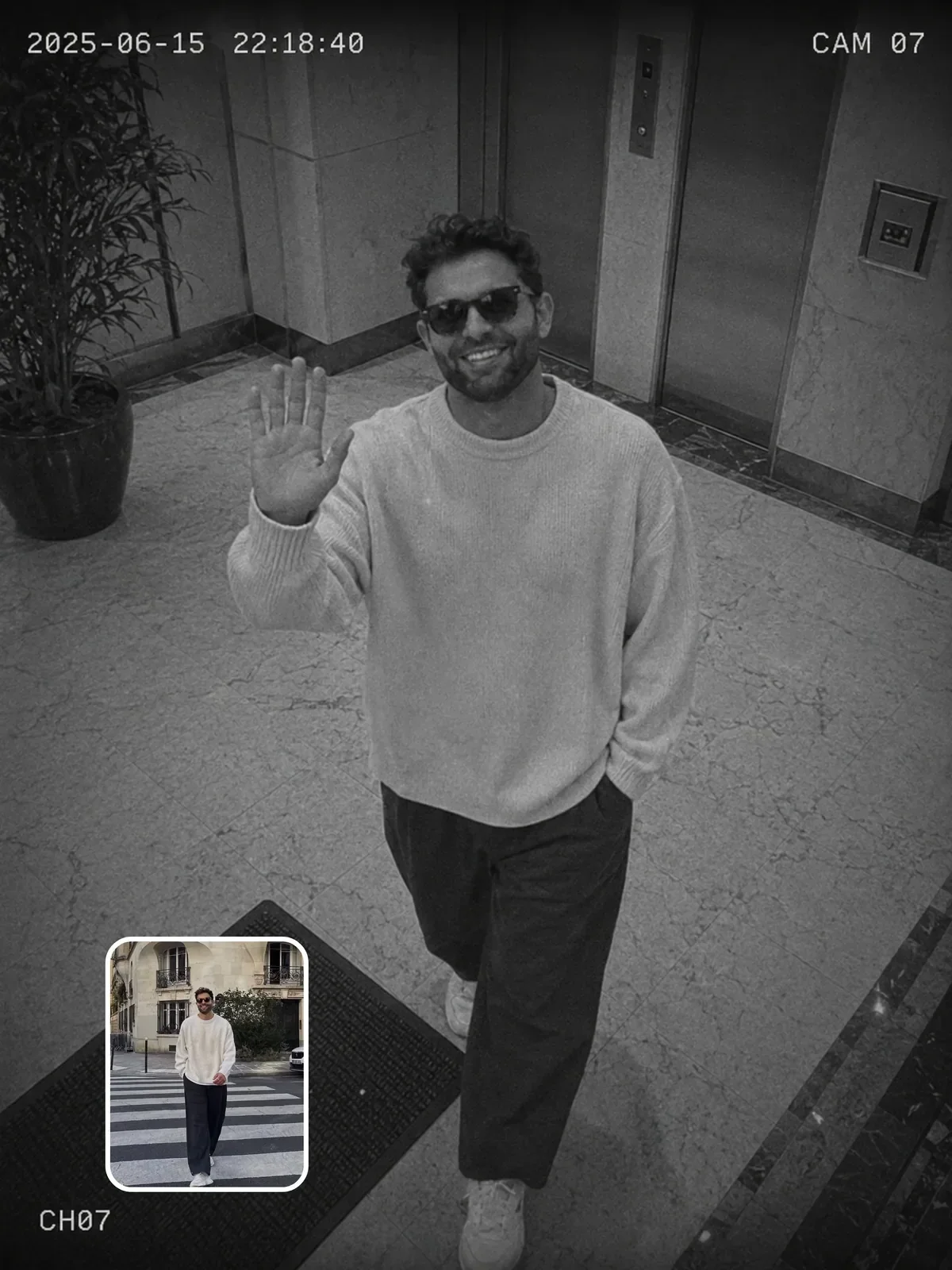
That watched feeling is why surveillance imagery always comes from above. The CCTV surveillance scene prompt relies on a high corner-mounted viewpoint; move that camera to eye level and the found-footage feeling vanishes.
Overhead, top-down and bird's-eye
These three are often mixed up, so be specific in your prompt:
- Overhead or top-down: the camera points straight down at 90 degrees. Perspective flattens and the frame becomes a layout. This is the flat lay of food and product photography, and the classic shot of a person lying on a bed of flowers or a patterned floor.
- Bird's-eye view: high above the scene, often looking down at a steep but not perfectly vertical angle, showing the subject within a wide landscape or street.
- Aerial or drone view: very high, covering whole neighborhoods, coastlines or fields, with people reduced to tiny shapes.
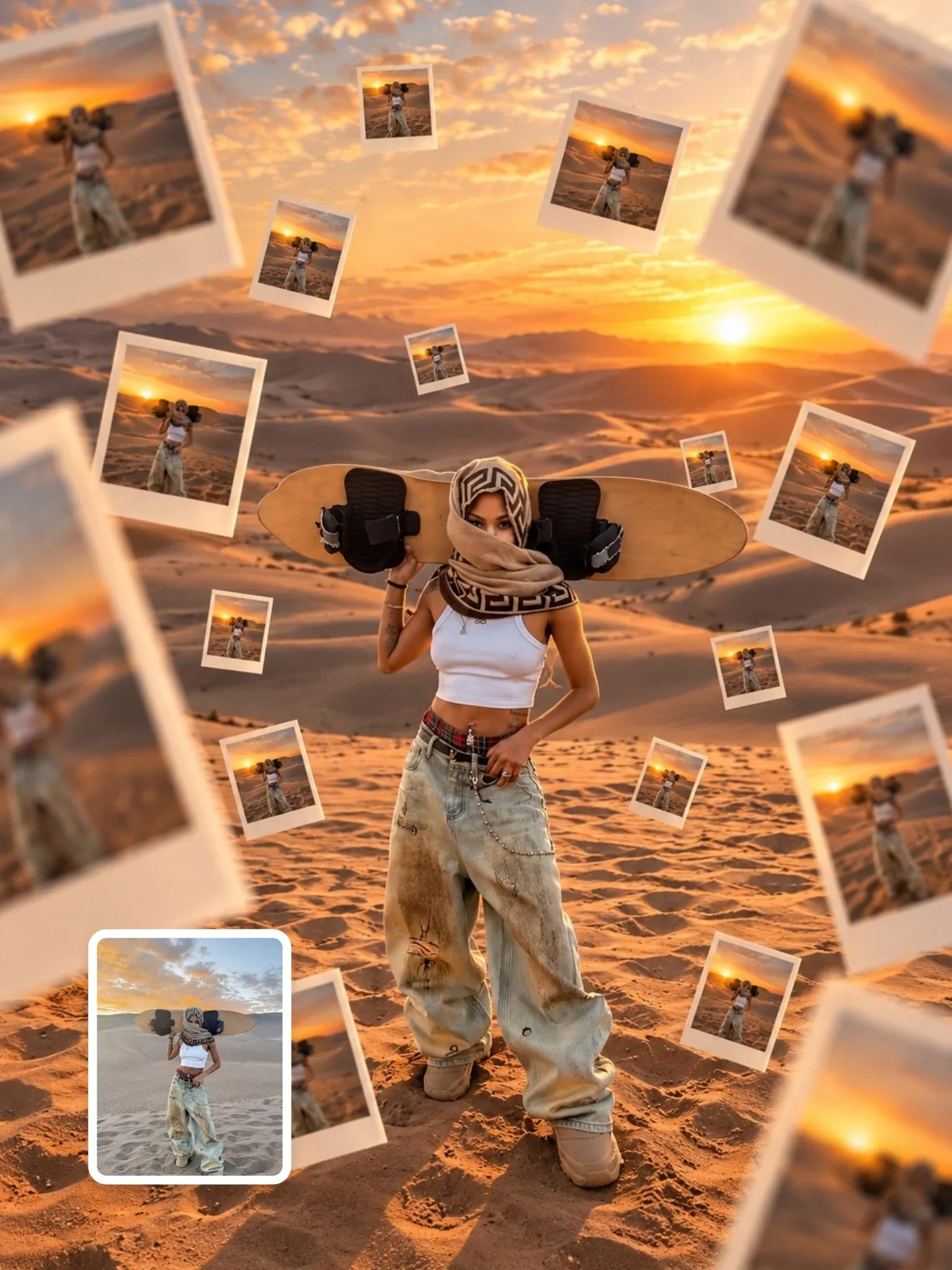
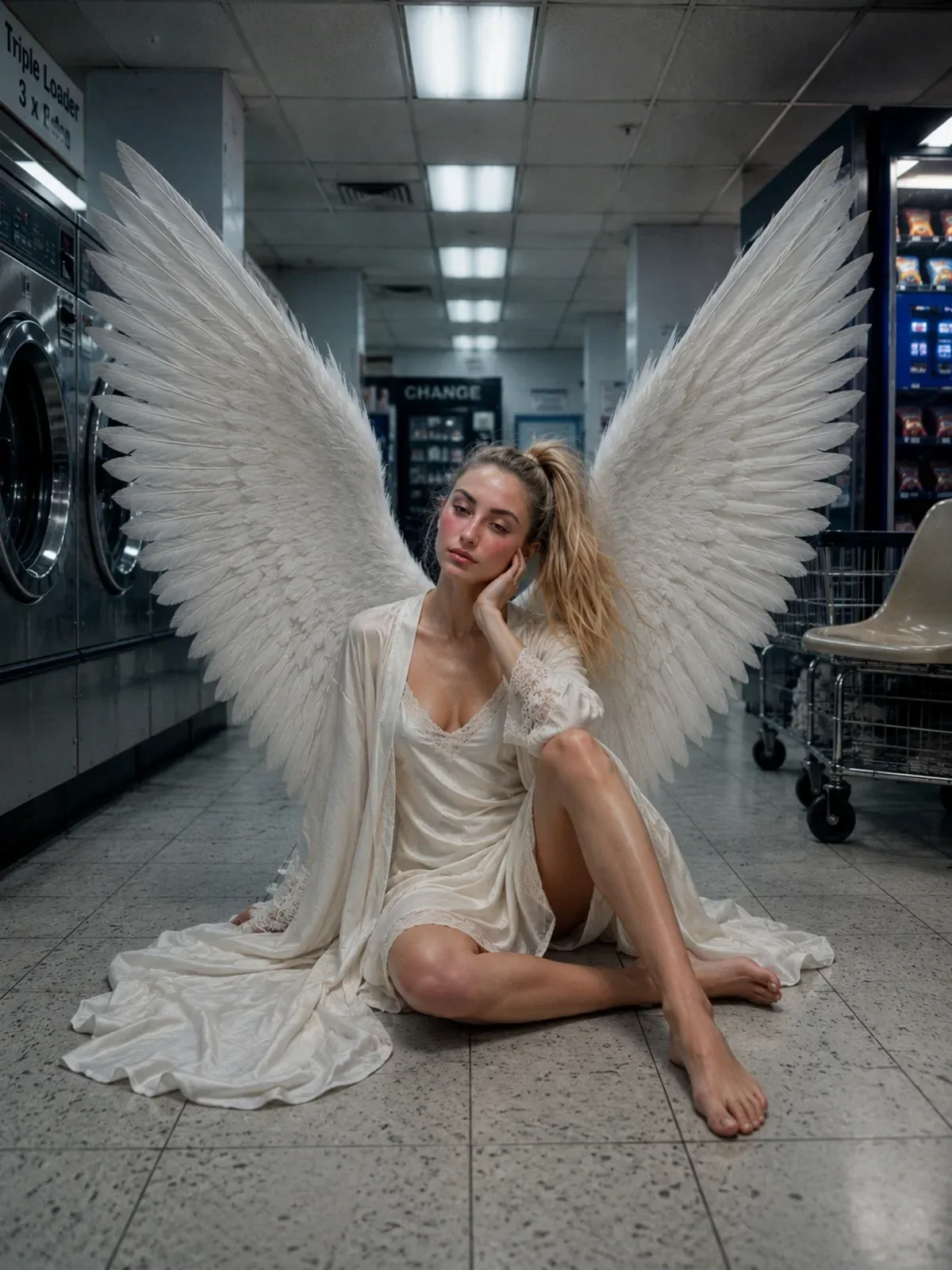
The hero image for this guide, from the angel on the floor prompt, uses an overhead view: the floor becomes the canvas and the figure becomes a shape on it.
Dutch angle: tilting the horizon
A Dutch angle, also called a canted angle, rotates the camera around the lens so the horizon runs diagonally. Film directors use it to signal that something is wrong: confusion, danger, a character losing control. In fashion and sports it adds raw energy.
The tilt needs to look intentional. A barely tilted horizon looks like a mistake, and an extreme one turns the image into a gimmick. A clear, moderate tilt, somewhere around 15 to 25 degrees, usually reads as a deliberate choice. Say the direction too: camera tilted 20 degrees clockwise, the horizon running from lower left to upper right.
Models sometimes straighten Dutch angles back to level because most of their training photos are level. Name the evidence: tilted horizon, walls and doorframes leaning diagonally. Vertical lines that lean are proof the camera rotated.
Give the model evidence for the angle
A single angle word competes with everything else in the prompt. What makes an angle stick is describing what the camera would actually see from that position. These clues work across tools:
- Horizon position:
horizon low, below the kneesfor low angles;no horizon visible, only floorfor overhead. - What fills the background: sky and ceiling for low angles, ground and floor for high angles.
- Visible surfaces: the underside of a chin, a hat brim or a balcony from below; the tops of heads and shoulders from above.
- Converging lines: buildings narrowing toward the sky in a low angle, or toward the ground from above.
- Camera height in real units:
camera on the ground,at hip height,from a second-floor window.
Put the angle near the start of the prompt, right after the subject. Words placed early tend to shape the overall layout, while words at the end tend to affect details. For the order of a full prompt, see the anatomy of a great image prompt.
Angles and lenses work together
An angle's effect gets stronger with a wide lens and gentler with a long one. A low angle with a 24mm lens close to the subject stretches legs and makes the head small and distant: dramatic, sometimes comic. The same angle with an 85mm lens from further away feels dignified and calm. If a low-angle portrait looks distorted, keep the angle and lengthen the lens. The focal length guide explains why.
Exercise: a five-angle contact sheet
Pick one subject, like a person on a staircase, a cup on a café table or your dog in the garden. Keep the prompt identical except for one angle sentence, and generate five versions:
- Eye level, horizon through the eyes.
- Low angle from knee height, sky behind.
- High angle from a first-floor window, ground as the background.
- Overhead, straight down, no horizon.
- Dutch angle, 20 degrees clockwise, leaning verticals.
Put them side by side and ask what each one says about the subject. Choosing an angle is choosing a point of view, and after this exercise you'll pick it on purpose instead of accepting the default. Also note which angles your tool followed on the first try and which needed extra evidence. Save the ones that needed help together with the clue phrases that fixed them, so next time they work on the first attempt.